


Change in length for a bar with continuously varying load or dimensions
sometimes the axial force and the cross-section area varies along the length of the bar. for this case the equation δ=(PL)/(AE) will not be applicable , figure 1 shows a bar with continuously varying load and cross-section area along the length L, for P(x) acting at point A and varying along the length of the bar with force of PB at point B. the force acting along the bar is function of distance (unit of pound per inch or newton per meter). A distributed axial load may be produced by such factors as centrifugal forces, friction forces, or the weight of a bar hanging in a vertical position.
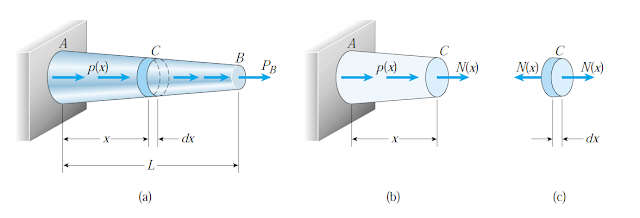
To compute the change of length for this case, we should integrate the change in length of a differential element of the bar and then integrate over the length of the bar. in general the force is the function of x(change in length) as shown in figure b, the cross-section area A(X) also function of X, we should derive the relation of A as a function of X then use the equation below to calculate the change in length of bar.


Figure 1
dδ=(N(X)*dx)/(A(X)*EA)
Example (click here)







Comments
Post a Comment