


Structural analysis for cable subjected to point load
Cables are used to support many structures. We can find cables supporting electrical transmission towers, cable-stayed bridge, and suspension bridges. Cables are used almost every day in the construction sites. Cranes using cables to assist in loading and shifting materials. Cables are assumed to be flexible and inextensible. The flexibility of cables means the cable will not be subjected to shear or bending moment. The force acting to cables is always tangent at points along its length. Inextensible means the cable will preserve the same geometry after applying the loads. This means the cable segment will keep the same shape after applying the load, and it is treated as a rigid body.
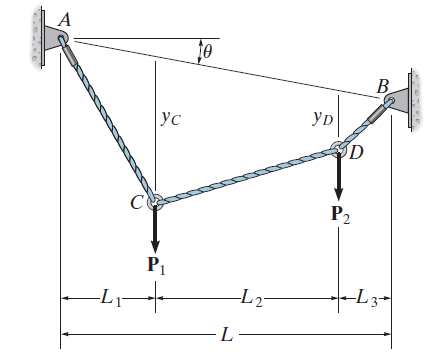
The analysis of cables is similar to other structures. Cables will carry only axial forces without any shear and bending. Considering the example in figure 1. the number of unknown forces equals seven. Two unknown forces for each support and axial forces for each cable segment. By applying the equilibrium equations and geometric analysis, we can obtain all unknowns for this system.


ΣMA=0
The analysis of cables is similar to other structures. Cables will carry only axial forces without any shear and bending. Considering the example in figure 1. the number of unknown forces equals seven. Two unknown forces for each support and axial forces for each cable segment. By applying the equilibrium equations and geometric analysis, we can obtain all unknowns for this system.
Figure 1

Figure 2
considering the cable system in figure 2. the cables are loaded at point B and C. figure 3 showing the free body diagram.

Figure 3
-3*2+-8*4+TCD*(4/5)*(5.5)+TCD*(3/5)*2=0
TCD=6.79 kN

ΣFx=0
-TBC*Cos(θ)+6.79*(3/5)=0
TBC*Cos(θ)=4.07----------Equation A
ΣFY=0
+TBC*sin(θ)+6.79*(4/5)-8=0
TBC*sin(θ)=2.568kN-----------Equation B
Divide equation B on A
(TBC*sin(θ)=2.568kN)/(TBC*Cos(θ)=4.07)
Tan(θ)=0.63
θ=32.3
TBC=4.82kN

ΣFx=0
TBA*Sin(θ)-4.82*sin(32.3)-3=0
TBA*Sin(θ)=5.57----------Equation A
ΣFY=0
-TBA*Cos(θ)+4.82*Cos(32.3)=0
TBA*Cos(θ)=4.07kN-----------Equation B
Divide equation A on B
(TBA*Sin(θ)=5.57)/(TBA*Cos(θ)=4.07kN)
Tan(θ)=1.368
θ=53.83
TBA=6.89kN

Figure 4
-TBC*Cos(θ)+6.79*(3/5)=0
TBC*Cos(θ)=4.07----------Equation A
ΣFY=0
+TBC*sin(θ)+6.79*(4/5)-8=0
TBC*sin(θ)=2.568kN-----------Equation B
Divide equation B on A
(TBC*sin(θ)=2.568kN)/(TBC*Cos(θ)=4.07)
Tan(θ)=0.63
θ=32.3
TBC=4.82kN

Figure 5
TBA*Sin(θ)-4.82*sin(32.3)-3=0
TBA*Sin(θ)=5.57----------Equation A
ΣFY=0
-TBA*Cos(θ)+4.82*Cos(32.3)=0
TBA*Cos(θ)=4.07kN-----------Equation B
(TBA*Sin(θ)=5.57)/(TBA*Cos(θ)=4.07kN)
Tan(θ)=1.368
θ=53.83
TBA=6.89kN







provide solution for problem 2 please!!
ReplyDelete